test

2 End hunger, achieve food security and improved nutrition and promote sustainable agriculture

goal 3

goal 4

goal 5

goal 6

goal 7

goal 8

goal 9

goal 10

goal 11

goal 12

goal 13

goal 14

goal 15

Goal 16
16.3: Promote the rules of law and the national and international levels and ensure equal access to justice for all.
16.5: Substantially reduce corruption and bribery in all their forms
16.7 Ensure responsive, inclusive, participatory and representative decision-making at all levels
16.b: Promote and enforce non-discriminatory laws and policies for sustainable development

Goal 17
CUSTOMER ENGAGEMENT
Customer Engagement Strategy
BJC have always strived to meet the daily needs of all customers, evident from the corporate value Customer at Heart, which includes commitments to treat customers first, go the extra mile to exceed expectations and to provide the best value & quality with efficiently outstanding services and speed. The commitment derived from BJC’s recognition of customers influence as a fundamental driver to BJC’s success, which enables long-term and sustainable growth for BJC and relevant stakeholders, therefore a strong relationship with customers, formed through effective customer engagement remains to be a key component of BJC’s operations, despite the many challenges faced throughout the years of operations.
Through BJC's operations, it continuously faces new disruptions caused by various economical, sociological and environmental influences, the business-as-usual approach to engage with customers is no longer effective and limited through various safety and lockdown procedures to control the spread of the virus, and shifting customer behavior and expectations. In order to manage this change, BJC have since increased the reliance and utilization of digital technologies, forever redefining business processes and customer relationship management strategies.

BJC also acknowledges the actual and potential negative and positive impacts on the economy, environment, and people, including impacts on their human rights to no discrimination. Should BJC fail to effectively manage customer engagements, it risks facing a chain of negative consequences, including loss of customers, negative reputation and ultimately revenue, while a well-managed customer engagement will result in positive benefits such as customer loyalty, increase customers, and brand awareness to name a few. Despite the challenges presented from the evolving customer demands in the new market environment, BJC remains committed to continue fostering a robust customer relationship engagement, through active and customized customer management services to meet all customer’s everyday needs, and become a top-of-mind brand amongst customers.
Customer Engagement Approach
BJC deals with many forms of customers throughout the different supply chains, including both business-to-business (B2B) and business-to-customers (B2C), with the largest proportion of customers being B2C from the modern retail supply chain, where Big C operates. For this reason, B2C customer engagement is selected as the primary customer engagement procedure.
Evident from BJC’s mission to serve customers’ personal needs based on customer-centric and data-driven culture, BJC have longed prioritized a strong relationship with customers. Doing so comes with various challenges, as both business-to-business (B2B) and business-to-customer (B2C) customers and consumers continue to evolve according to the market environment. To effectively manage this, BJC complies with the Customer Relationship Management Process, a corporate-wide guideline developed by the Big C Marketing Department, overseen by the Big C Customer Relationship Management Department. The process provides BJC with a clear and comprehensive guideline to manage all customer complaints.
Customer Satisfaction
Big C have evaluated customer satisfaction since 2017, through the Voice of Customer (VOC) Program, collecting customer data using QR Codes, printed at the end of all customer shopping recipes or through a aonnection to Short Messaging Service (SMS). Providing customers with easy access customer satisfaction survay on their smartphones. When Big C recived notification of a dissatisfield customer, this infomation is passed on to the responsible department in order to identify the issue and improvement opportunities, which are conducted through a close-loop feedback service, where relevant department communicates with the customer in question to inform them that the issue is being investigated accordingly. BJC utilized this data as a primary method to consolidates data and analysis customer's needs in each supply chain, enabling BJC to developed high-quality products and services which meets the needs to all customers.
|
Satisfaction Measurement (%) |
2022 |
2023 |
2024 |
2025 |
Target for 2025 |
|
Satisfaction measurement (% of satisfied respondents out of total |
90 |
91 |
93 |
93 |
93
|
|
Data coverage: (% of customers/consumers surveyed (both respondents and non-respondents) out of total number of customers/consumers, % of revenues, etc. |
100 |
100 |
100 |
100 |
100 |
Note: Data coverage 100% of consumers surveyed
The Company has set a customer satisfaction target of 93%, recognizing that maintaining a consistently high level of customer satisfaction is increasingly challenging in a dynamic retail environment. In 2025, the VOC methodology was strengthened by replacing the rating scale with a binary Yes/No assessment for selected service attributes, resulting in a more rigorous evaluation of customer satisfaction. The target therefore reflects both the Company's commitment to maintaining high performance and the increased stringency of the assessment methodology. Customer insights are regularly analyzed and translated into action plans to improve service quality, product availability, and the overall customer experience.
The target is reviewed periodically to ensure it remains both ambitious and achievable, taking into account historical performance, evolving customer expectations, and improvements in the Company's customer satisfaction measurement methodology.
Cascaded from BJC Big C's continued emphasis to meet customer expectation and commitment to deliver high product safety and quality beyond expectations. This is implemented through categorization of identified issues into short- medium- and long-term improvement plans, depending on the type of issue, duration of work and budget requirements, such as development of service training of store employee and improve member benefits and improve all Big C branches through renovations.
Over the past year, short-, medium- and long-term improvement implemented such as improved accuracy of cashier's staff in transactions, reduced number of out-of-stock products, as well as improved quality of fresh food were met with positive responses from customers, compared to feedback from previous years. Yet, BJC remain committed to continue its improvements to meet the shortcoming in the past reporting year, which has caused the VOC result results to lag from previous years.
Customer Complaint and Grievance Management
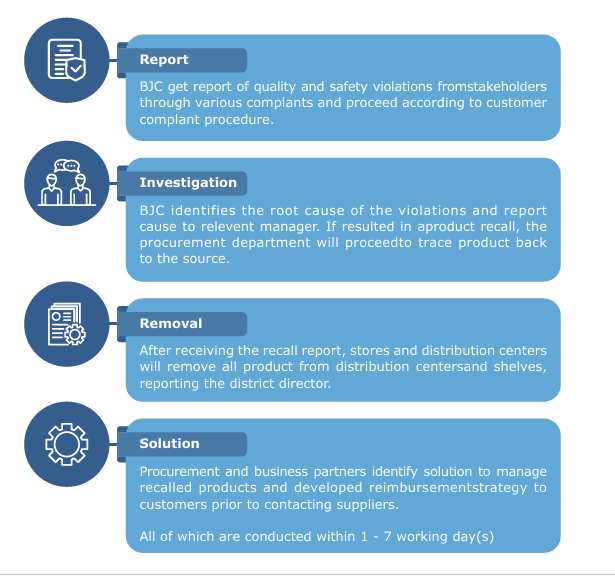
Regardless of the changes in the market environment, BJC remains committed to serve all customers and consumers with the highest products and services which are safe and of high quality as possible, and respects the view and opinions of all customers, recognizing this feedback as an importance source of information which enables BJC to better meet the customer daily needs.
For this reason, BJC continue to utilize the various established transparent and inclusive grievance channels for customers to voice their views, and opinions and report any safety and quality concerns, questions or suspected violations regarding BJC's products and through the provided channels, which will be promptly identified and remediated by the quality assurance department or accountable department in accordance with the complaint.
Beyond this, BJC also established a clear and transparent Grievance Management procedure, guided by BJC's value to the views, opinions, and feedback from all customers. In 2025, through the analysis of customer feedback consolidated through various channels, BJC found that customer are reporting complaints related to, customer service of employees, product labeling add price tags, and location and branch facilities. All complaints are sent to relevant branch managers to remediate within an appropriate timeframe, and in collaboration with relevant customers (if applicable), to elevate BJC Big C products and services and meet customer needs.
All customer complaints received through Big C’s customer contact channels are recorded and assigned to relevant responsible functions for investigation and resolution through the Closed Loop Feedback system. The Company has established a Service Level Agreement (SLA) to ensure timely complaint handling. Responsible functions are required to review, resolve issues, and provide responses to customers within 24 hours. For cases requiring further investigation, customers will be contacted to provide progress updates and resolution information. Through this process, BJC Big C continuously improves its products and services to better meet customer needs.
Online Customers and Online Revenue
| % of total customers using online services solutions/sales platform | 2022 | 2023 | 2024 | 2025 | Target 2025 | |
| 0.84 | 1.09 | 1.58 | 2.66 | 2.10 | ||
| % of revenues generated online | 2022 | 2023 | 2024 | 2025 | Target 2025 | |
| 1.87 | 2.16 | 2.93 | 4.13 | 3.70 | ||
Remark: Data covers e-commerce activities and are prepared in accordance with DJSI requirement.
Big C Shopping Online
Online Business: Despite Thailand’s slower economic growth in 2025 and more cautious consumer spending, the online retail market continued to expand, driven by consumers’ increasing preference for convenience, speed, and seamless omnichannel shopping experiences. In response to these evolving consumer behaviors, the Company continued to enhance Big C Online by expanding its product assortment, improving the user experience, strengthening digital payment and delivery capabilities, and integrating its online platform with Big C stores nationwide. These initiatives enable customers to shop more conveniently across all channels while reinforcing the Company’s omnichannel retail strategy and supporting the continued growth of Thailand’s digital economy.
1. Big C Online and Omnichannel Retailing
Big C Online continues to operate under the proposition “Easy order, fast delivery, and everything customers need” through the Big C website and Big C PLUS application. The platform integrates online shopping, Big Point benefits and digital coupons, while offering home delivery, express delivery in selected areas, and Click-and-Collect services through Big C’s nationwide store network.
In 2025, Big C strengthened its online fulfilment capabilities by expanding its OSX Hub network to 75 locations, opening the Bang Pa-in distribution centre, and enhancing logistics operations through collaboration with DHL. The company also applied GIS, Big Data, and AI to optimise branch selection, delivery routes, truck utilisation, and operating costs. Big C Online continues to offer a wide range of products, including fresh and packaged food, household goods, furniture, electrical appliances, health and beauty products, and selected Pure Pharmacy items.
2. Marketplace and Quick-Commerce Platforms
In 2025, Big C continued to expand beyond its own website and application by operating official stores on major online marketplaces, particularly Shopee and Lazada. These platforms allow customers to purchase packaged consumer goods, household items, electrical appliances and selected Big C private-label products while benefiting from marketplace-specific campaigns, vouchers and payment options.
Big C’s wider digital sales ecosystem also includes social and specialist commerce platforms such as TikTok Shop, while quick-commerce orders are supported through platforms including GrabMart and LINE MAN MART. These partnerships enable customers to purchase groceries and daily necessities from nearby Big C branches and receive them through on-demand delivery services. This multi-platform strategy is particularly important in the 2025 economic environment, as customers increasingly compare prices, delivery fees, promotional codes and delivery times across several applications before completing a purchase.
3. Cross-Border E-Commerce and International Tourist Platform
Big C continues to engage Chinese consumers and international tourists through WeChat, Weibo, Xiaohongshu, and WeChat Pay, supporting product communication, promotions, and confidence in the authenticity of Thai products.
In 2025, Big C enhanced the “Thailand BigC” Mini Program, enabling tourists to browse and order products before or during their trip, with options for in-store pickup, hotel delivery, or airport delivery. The platform also provides digital coupons and exclusive tourist promotions.
This development reflects Big C’s shift from traditional cross-border shipping toward tourist commerce and pre-arrival shopping, allowing customers to reserve products in advance and receive them through local fulfilment points in Thailand. Big C also strengthened its international presence by opening a new flagship store in Hong Kong, increasing brand visibility and expanding access to Thai products for consumers in Hong Kong and mainland China.
4. Social Commerce and Call-Chat-Shop Service
In 2025, Big C continued its Call-Chat-Shop service, allowing customers to contact nearby branches via LINE or telephone to check product availability, receive recommendations, view promotions, reserve items, and place orders directly with branch staff. Customers can choose home delivery or in-store pickup, depending on branch availability.
The service supports customers who prefer personalised assistance, including elderly shoppers and those seeking information before purchasing. Through its Digital Localization strategy, Big C uses LINE Official Accounts at more than 1,600 branches, enabling each branch to communicate relevant promotions and product information to local customers.
By integrating social commerce, branch inventory, and assisted fulfilment, Big C connects online interactions with physical stores while offering Big Point benefits, promotions, and flexible delivery or pickup options. This strengthens customer convenience, trust, and loyalty.
Customer Relations Management
In 2025, Big C continued its Call-Chat-Shop service, allowing customers to contact nearby branches via LINE or telephone to check product availability, receive recommendations, view promotions, reserve items, and place orders directly with branch staff. Customers can choose home delivery or in-store pickup, depending on branch availability.
The service supports customers who prefer personalised assistance, including elderly shoppers and those seeking information before purchasing. Through its Digital Localization strategy, Big C uses LINE Official Accounts at more than 1,600 branches, enabling each branch to communicate relevant promotions and product information to local customers.
By integrating social commerce, branch inventory, and assisted fulfilment, Big C connects online interactions with physical stores while offering Big Point benefits, promotions, and flexible delivery or pickup options. This strengthens customer convenience, trust, and loyalty.
1. Customer Support and Feedback Channels
Details:
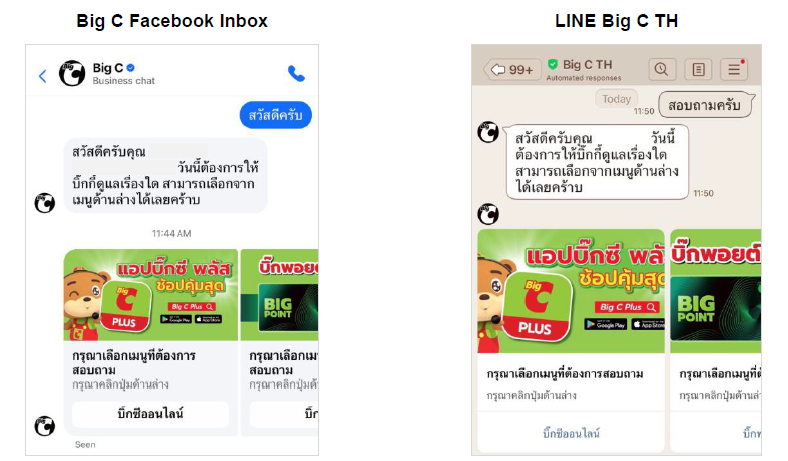
BJC provides multiple channels for customers to contact, request assistance, or give feedback:
- Call Center (1756): Direct calls from customers at all branches, with a system to track history and issues.
- AI-based Chatbot & Live Agent: Provides initial responses and forwards complex issues to staff.
- Social Media: Facebook, LINE, Shopee, Lazada, TikTok Chatbot.
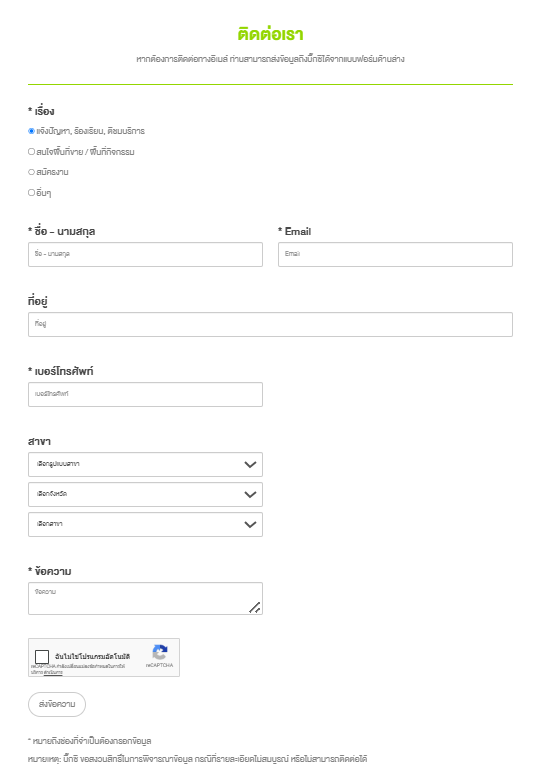
- E-mail / Online Form: Customers can submit complaints or feedback with automated acknowledgment.
- In-person: Customers can report issues directly at branches.
- Monitoring: Social listening team tracks online feedback and comments from platforms such as Pantip or public groups.
- Confirmation to the customer that the complaint has been received, regardless of the channel used, including chat, email and other customer service channels.
Activities: The system ensures customers have easy access and incorporates a Closed Loop System to guarantee all issues are addressed.
2. Process to Incorporate Customer Feedback into Product and Service Development
Details:
- Customer feedback from all channels is recorded in a central database.
- Alert System: Relevant Business Units (BUs) are immediately notified.
- Analysis: BUs analyze feedback and prioritize actions.
- Implementation: Insights from customer feedback are incorporated into product development, service enhancement, and customer experience improvement initiatives.
- Follow-up: Teams ensure feedback is implemented and cases are closed according to SLA.
Activities: This system enables fast product and service improvements, provides data-driven decision support, and reduces errors.
3. Customer Service Improvement Mechanisms for Disabled or Elderly Customers
Details:
- Branch accessibility improvements such as ramps and elevators.
- Special service channels: Priority queues for elderly and disabled customers.
- Facilities: Accessible restrooms and support amenities for disabled customers.
- Communication and service are designed for elderly customers, e.g., large screens, clear fonts, and staff assistance.
Activities: Branch teams are trained to provide appropriate service, and accessibility standards are regularly monitored.

4. Complaint Handling and Resolution Process
Details:
- Customers submit complaints through any channel → Managed via the Closed Loop System.
- Assignment: Cases are assigned to the relevant BUs.
- Monitoring: Alerts are triggered if the SLA is exceeded.
- Resolution: BUs investigate and resolve the customer’s issue, implement appropriate corrective actions, and respond to the customer via email within 24 hours. Once the case is resolved, the customer is informed of the outcome and the case is closed.
- Follow-up: Review outcomes to assess customer satisfaction.
- External Verification / Relevant Standards
- BJC uses Contact Center KPIs to measure service quality, e.g., % Served Customers, Average Handling Time, CSAT.
- Standards referenced include ISO 9001
- Internal and external audits/evaluations are conducted to ensure complaint handling aligns with international standards.
Activities: Automated tracking, service quality audits, and KPI reporting are in place. Monthly quality assessments, reporting to management, and continuous process improvement.