
test

2 End hunger, achieve food security and improved nutrition and promote sustainable agriculture

goal 3

goal 4

goal 5

goal 6

goal 7

goal 8

goal 9

goal 10

goal 11

goal 12

goal 13

goal 14

goal 15

Goal 16
16.3: Promote the rules of law and the national and international levels and ensure equal access to justice for all.
16.5: Substantially reduce corruption and bribery in all their forms
16.7 Ensure responsive, inclusive, participatory and representative decision-making at all levels
16.b: Promote and enforce non-discriminatory laws and policies for sustainable development

Goal 17
Responsible Artificial Intelligence
At BJC, Artificial Intelligence (AI) presents opportunities to enhance operational efficiency, strengthen decision-making, improve customer experience, and support sustainable business growth across the Company’s operations. AI technologies can also contribute to resource optimization and cost reduction.
However, the increasing use of AI may expose the Company to risks related to data privacy, cybersecurity, bias and discrimination, lack of transparency, intellectual property protection, and evolving regulatory requirements. Inadequate governance or misuse of AI systems could result in operational, legal, and reputational impacts.
BJC recognizes the importance of responsible AI governance and is committed to promoting the ethical, transparent, and secure use of AI technologies in alignment with applicable laws, regulatory expectations, and stakeholder trust.
Management Approach
BJC demonstrates its commitment to responsible Artificial Intelligence (AI) governance through a Responsible AI Policy approved by the Board of Directors. The Board provides strategic oversight, the Management Board oversees policy implementation, and the Group Digital Technology function is responsible for operational execution.
In addition, BJC has established a cross-functional AI governance structure to oversee the responsible use, development, and deployment of AI technologies across the organization.
The policy establishes principles and controls to ensure the responsible, ethical, and secure use and/or development of AI across the organization.
Through this governance approach, BJC aims to promote responsible AI adoption while managing associated ethical, operational, regulatory, and societal risks.
At BJC, AI applications are subject to a risk assessment process prior to deployment to support the responsible and secure use of AI technologies across the organization. The assessment process includes risk screening, classification of AI applications based on risk level, and evaluation of potential impacts relating to data privacy, cybersecurity, bias, and ethical considerations.
For AI applications identified as high-risk, BJC applies enhanced governance and oversight measures, including additional review and approval processes, monitoring controls, and appropriate human oversight mechanisms.
In addition, AI-related incidents, concerns, or anomalies can be reported through the Company’s whistleblowing channels for investigation, remediation, and corrective action, in line with BJC’s governance and compliance processes.
Responsible Artificial Intelligence Programs
BJC recognizes that the increasing integration of Artificial Intelligence (AI) into business operations and daily life may create significant impacts on society and the environment. BJC therefore emphasizes the responsible and ethical use of AI technologies to mitigate potential risks related to privacy, bias, security, transparency, and environmental impacts.
To support responsible AI deployment, BJC has implemented several measures and controls, including:
• Limiting access to sensitive AI capabilities
BJC limits access to sensitive AI capabilities through a combination of governance requirements and information security controls. Under the Company's AI Policy, the use of AI with sensitive or high-impact capabilities, including facial recognition, biometric identification, surveillance, profiling, and automated decision-making in significant contexts, is subject to appropriate governance, prior approval, and risk-based controls.
The AI Policy further requires AI development and uses to respect privacy and protect personal data in accordance with applicable laws and internal requirements. Personal data, customer information, employee information, confidential business information, and other sensitive data may only be used for authorized purposes, to the extent necessary, and under appropriate governance and security measures.
These requirements are supported by the Company's Access Control Policy and Information Security framework. Access to AI-related systems and sensitive information is granted only to authorized personnel based on business need. Additional safeguards include role-based access control, data classification, encryption, Data Loss Prevention (DLP), and user activity monitoring. Information is classified into four levels—Highly Confidential, Restricted, Internal, and Public—with appropriate controls applied throughout the data lifecycle.
Within selected business units, facial recognition technology is used solely for employee time attendance purposes. Access to biometric data and related systems is restricted in accordance with the Company's access control and data protection requirements to prevent unauthorized access or misuse.
• Clearly labeling AI-generated content and AI-driven decisions
BJC promotes transparency in the use of Artificial Intelligence (AI) by requiring appropriate disclosure when AI-generated content is used in official communications. Under the Company's AI Policy, AI-generated or AI-assisted content is subject to human review and approval before publication to ensure its accuracy, appropriateness, and compliance with corporate standards.
As part of this approach, AI-generated visual content used in selected corporate communications, such as social media advertisements and promotional materials, is clearly labeled to inform audiences that AI has been used in the content creation process. This enables stakeholders to distinguish between AI-generated and human-created content while maintaining trust and transparency.
Where AI is used to support business decisions, AI outputs serve only as decision-support tools. Final decisions remain the responsibility of authorized personnel through appropriate human review and oversight.
Examples of implementation
• AI-generated images published on the Company's official social media channels include a disclosure such as "AI-generated image" or "Created with AI."
• Marketing and communication materials produced using generative AI are reviewed and approved by responsible personnel before publication.

• Monitoring AI Performance and Addressing Model Degradation
BJC periodically monitors the performance of AI-enabled systems to ensure that they continue to operate effectively and deliver the intended business outcomes. As the Company primarily deploys vendor-provided AI solutions rather than developing AI models internally, performance monitoring focuses on operational effectiveness, output quality, and alignment with business objectives.
Responsible business units regularly review operational performance indicators relevant to each AI application. Where abnormal outputs, reduced performance, or operational issues are identified, the Company investigates the underlying causes and works with the technology vendor to implement appropriate corrective actions, such as system configuration updates, software enhancements, or model improvements provided by the vendor.
For example, the AI-powered ESIII Smart Glass Furnace system is monitored through operational indicators, including energy consumption, furnace performance, and production efficiency. Performance is reviewed periodically to verify that the system continues to deliver expected energy efficiency and operational benefits.
• Assessing AI Models for Fairness and Bias
BJC is committed to ensuring that AI systems are used fairly, responsibly, and in a manner that minimizes the risk of bias and discrimination. The Company's AI Policy requires AI to promote fairness, avoid discriminatory or inappropriate impacts on individuals or stakeholder groups, and prohibits the use of AI that creates, reinforces, or amplifies unfair or discriminatory outcomes.
For AI applications that are significant or classified as high risk, the AI Policy requires periodic monitoring and review based on the associated level of risk. These reviews are intended to verify that AI continues to operate safely, fairly, transparently, and appropriately for its intended purpose, while identifying and addressing any unintended impacts. The Company also continuously reviews and enhances its AI governance framework to reflect changes in technology, legal requirements, emerging risks, and industry practices.
As BJC primarily deploys vendor-provided AI solutions, oversight focuses on the governance and performance of AI applications rather than technical model development. Material decisions affecting stakeholders remain subject to appropriate human review and oversight.
• Initiatives to lower the ecological footprint of AI data
As BJC primarily utilizes cloud-based AI solutions, the Company focuses on maximizing the efficiency of digital operations while avoiding the need to develop and maintain dedicated AI infrastructure in-house. Environmental and sustainability considerations are incorporated into the evaluation and selection criteria for technology and cloud service providers. These criteria include the provider's use of renewable energy or renewable energy procurement mechanisms, data center energy efficiency, measures to optimize computing and resource utilization, and environmental management practices.
For example, Amazon Web Services (AWS), one of BJC's primary cloud service providers, has implemented sustainability measures across its cloud infrastructure, including renewable energy procurement, energy-efficient data center design, and energy efficiency monitoring through Power Usage Effectiveness (PUE). AWS reported a global average PUE of 1.14 for its data centers in 2025 and continued to match 100% of the electricity consumed by its global operations with renewable energy sources. AWS also provides customers with tools to monitor estimated carbon emissions and other environmental impacts associated with their cloud usage.
Through these supplier evaluation criteria and the use of cloud services with established sustainability practices, BJC seeks to reduce the environmental footprint associated with its digital and AI operations and promote responsible and sustainable practices throughout its technology supply chain.
• Providing Channels for Appeals or Contesting AI-generated Decisions
As of 2025, BJC does not deploy AI systems that make fully automated decisions with direct impacts on customers, employees, or other stakeholders. Decisions with material impacts remain subject to human review and approval.
Nevertheless, BJC maintains established communication channels, including the Company's website inquiry and complaint channels and Call Center, through which stakeholders can submit inquiries, comments, complaints, or requests for review. These channels are also available for reporting concerns related to AI-assisted services or AI-generated outputs, should such issues arise.
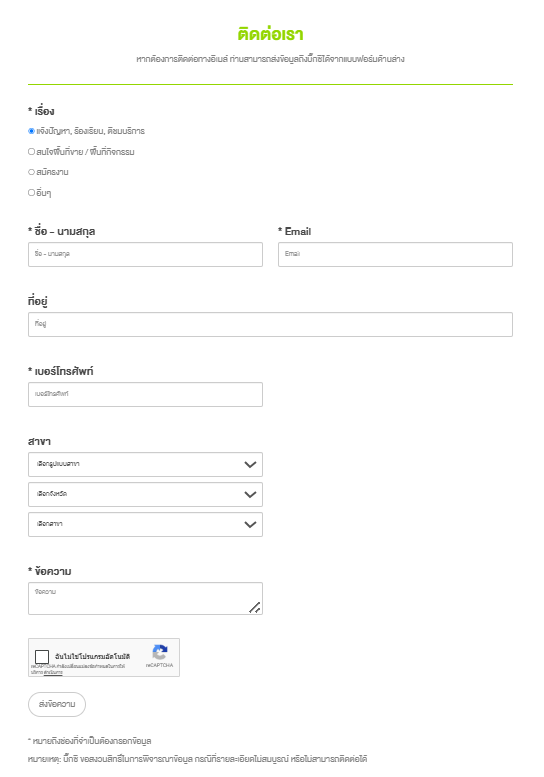
All submissions are reviewed by the responsible business function and handled in accordance with the Company's complaint management process. In 2025, BJC did not receive any complaints or appeals related to AI-generated decisions or outcomes.
• Quantifying the sustainability impacts of AI initiatives and tools to assess both operational benefits and broader environmental or social outcomes.
BJC leverages AI technologies to enhance operational efficiency while supporting sustainability objectives across its business operations.
o At BJC Glass, the AI-powered ESIII Smart Glass Furnace analyzes operational data to optimize energy consumption in the glass-melting process. The initiative has contributed to a reduction of approximately 2,000 tCO₂ in greenhouse gas emissions and cost savings of more than THB 2.5 million, demonstrating the potential of AI to improve energy efficiency while reducing environmental impact.
In the Annealing process, AI and IoT technologies are applied to optimize gas consumption. Sensor data and historical operational data are integrated and analyzed to determine the optimal gas flow rate while maintaining production efficiency and product quality. The initiative has achieved an annual gas consumption reduction of approximately 17,000 SCM/year, equivalent to approximately 41 tCO₂/year in avoided greenhouse gas emissions, with estimated cost savings of approximately THB 470,000 per year.
o In the retail business, BJC utilizes AI-driven customer analytics to better understand customer preferences and purchasing behaviors, enabling the Company to provide more targeted promotions and personalized offerings. These initiatives support improved marketing efficiency, inventory optimization, and enhanced customer experience.

• Employee Training on Responsible AI
BJC strengthens employee awareness and accountability in the responsible use of AI through a combination of policy, capability development, and practical training.
The Company's AI Policy promotes AI literacy among employees, users, and relevant personnel by requiring appropriate knowledge of AI technologies, their limitations, associated risks, and individual responsibilities. The Policy also emphasizes responsible AI practices, including ethical use, protection of personal and confidential data, compliance with applicable laws, and adherence to information security requirements.
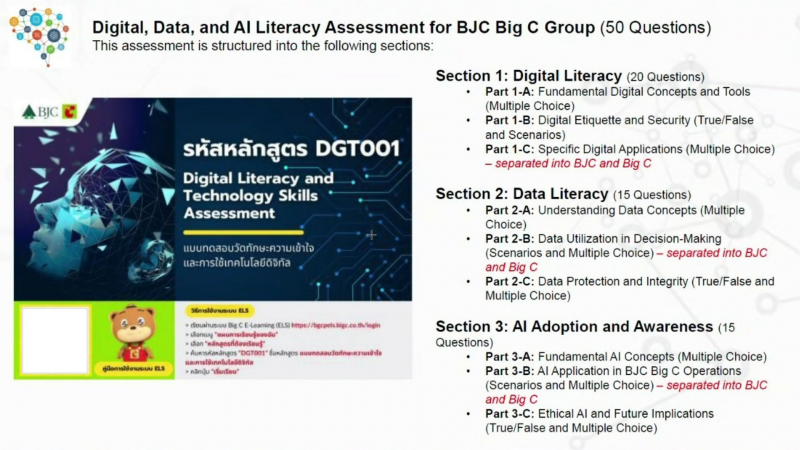
In 2025, BJC further enhanced workforce AI capability through its Digital & Data Literacy Empowerment Program, building on AI awareness initiatives introduced in 2024. The program provided AI Literacy training as part of a broader curriculum covering Digital Literacy, Data Literacy, and AI Literacy, reaching more than 30,000 employees across business units. Employees also received training on Digital Ethics, data governance, and responsible technology use to promote informed and accountable adoption of AI-enabled tools.
To strengthen practical AI adoption, BJC delivered dedicated Microsoft 365 and Copilot Training to more than 700 employees, focusing on the secure and effective use of AI-assisted productivity tools. Hybrid learning formats, combining classroom sessions with year-round e-learning, supported continuous learning and responsible AI practices across the organization.
The program achieved a post-training assessment score of 97.46%, compared with 92.44% before training, while 100% of participants attained the targeted Level 3 digital proficiency, demonstrating enhanced readiness to apply AI and digital technologies responsibly in the workplace.
In addition, BJC will continue to strengthen its AI governance framework by enhancing its internal policies, risk management processes, and oversight mechanisms. The Company incorporates relevant requirements of ISO/IEC 42001:2023 into its AI governance practices to promote the responsible, secure, and ethical use of AI.
BJC develops and deploys its AI applications on Amazon Web Services (AWS), utilizing AI services supported by an Artificial Intelligence Management System (AIMS) certified to ISO/IEC 42001:2023. This provides additional assurance that the underlying AI platform is governed in accordance with internationally recognized AI management practices.